
Trace Wilkinson County Former Owners
Work from the newest transfer toward the oldest one. Every entry in a deed-chain timeline should tie to the same tract through its legal description. A shared address or surname alone proves little. Treat any chain chart as a worksheet, never as a claim about a named parcel.
| Transfer date | Grantor to grantee | Deed type | Book and page |
|---|---|---|---|
| Newest recorded date | Prior owner to roll owner | Read the instrument heading | Start with the parcel-layer reference |
| Earlier recorded date | Earlier owner to prior owner | Confirm the interest conveyed | Take from the clerk index or deed |
| Next earlier link | Repeat with the last grantor | Note warranty, quitclaim, executor, or other form | Preserve volume and page exactly |
| Historic-book era | Indexed name to indexed name | Read original wording | Continue through books or microfilm |
Record both the execution date and the recording date whenever they exist, since the two can sit years apart. A corrective deed, an executor's deed, or a court order filed later often explains a break in an otherwise tidy sale sequence. The goal is rebuilding prior owners through linked instruments. Never assume every name change was a plain purchase.
Start Wilkinson County’s Former-Owner Chain
Wilkinson County's current parcel layer carries an owner name, parcel ID, and PPIN. It also shows deed book, deed page, deed date, and three legal-description fields. Those fields anchor a former-owner search. Use them to ask the Chancery Clerk for the cited instrument. The clerk records deeds, deeds of trust, and substitutions. The office also files liens, lis pendens, plats, and related land records. One caution applies. A deed of trust is not a sale; it secures a loan.
The county publishes no working online grantor-grantee index. The Land Title Association county inventory identifies the index families. It reports no online land-record link, though. The Chancery Clerk is therefore the active search channel. Give the office the current and prior owner names, the parcel key, and a street address. Add the legal description, section-township-range, any known book and page, and a narrow year span. Those details turn a vague request into a retrievable deed.
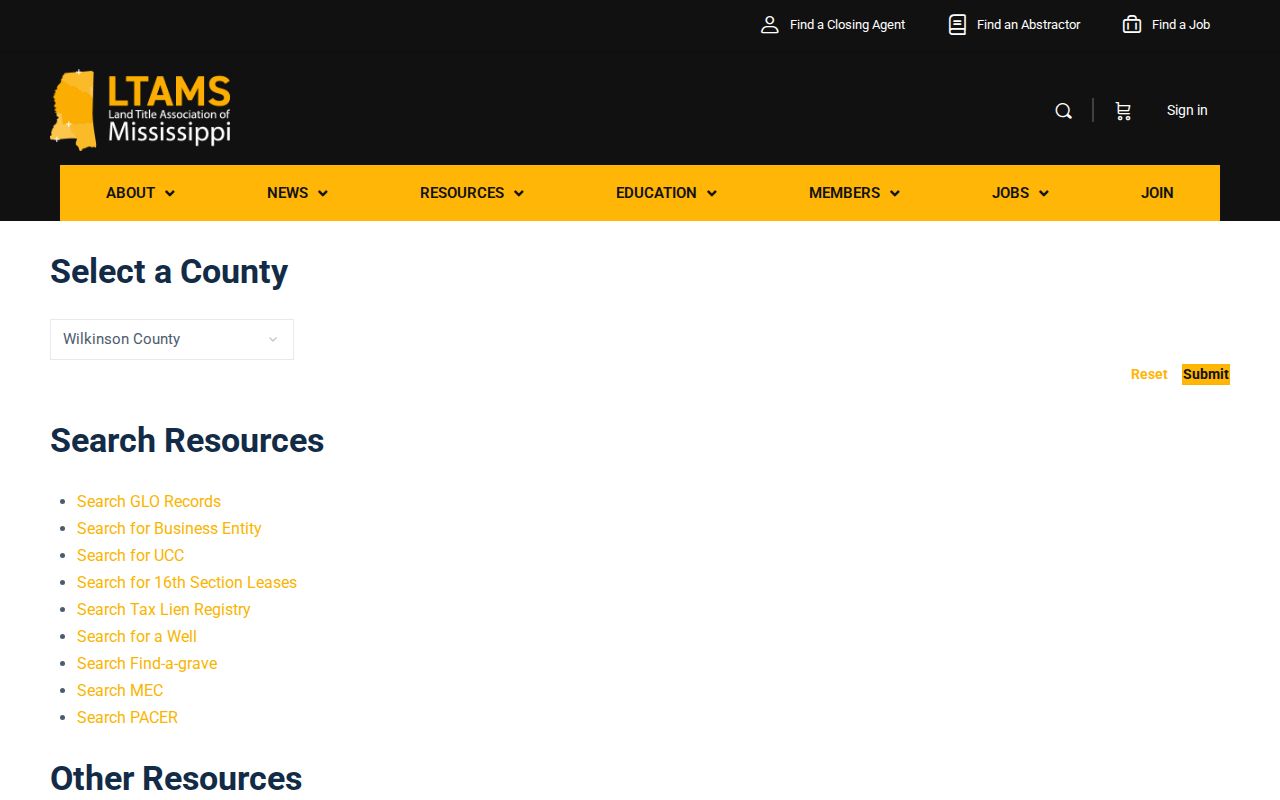
Not every record moves ownership. The inventory's deed, deed-of-trust, plat, lien, and lis-pendens categories show why a backward chain must separate true transfers from instruments that only burden or describe the land.
Reconstruct Wilkinson County’s Prior Owners
Once the latest deed is in hand, the grantor becomes the next person to trace. Keep the parcel identity fixed. Names change; the land does not. This method simply follows Wilkinson County's recorded trail in reverse.
- Read the newest deed. Copy the grantor, grantee, deed type, execution and recording dates, book and page, legal description, and any prior-deed citation.
- Confirm that its legal description matches the subject parcel. A deed may convey several tracts, so isolate the right one.
- Search the current deed's grantor as an earlier grantee. Ask the clerk to check both the general grantor and grantee indexes, plus the sectional index where useful.
- Open that earlier acquiring deed and repeat. Preserve initials, married names, entity suffixes, trustee terms, plantation names, and old road forms.
- When county books or office indexes no longer suffice, carry the last sound name, legal description, and book citation into MDAH and FamilySearch catalogs.
This method can name prior owners. It is still research, though, and a full title examination also weighs liens, releases, estates, court orders, easements, and other interests.
Wilkinson County Prior-Owner Terms
Older land records use short terms. Each carries a precise role, and defining them before taking notes keeps a former-owner chain in the correct order.
- Grantor
- The party who conveyed an interest in the deed being read.
- Grantee
- The party who received the stated interest.
- Chain of title
- The linked sequence of instruments through which the property interest passed.
- Reverse index
- An index arranged to approach instruments from the opposite party role, often used with grantor and grantee books.
- Quitclaim and warranty deeds
- Different deed forms whose words and legal effect must be read from the instrument, not guessed from an index line.
A book and page is only a locator. It says nothing about whether a chain is complete or valid. The legal description is the better test of whether two records concern the same land.
Wilkinson County Ownership Reaches 1803
The deepest historic horizon is a FamilySearch catalog lead cited by Mississippi State University. Wilkinson County land records there span 1803 through 1974. Indexes cover 1803 through 1971. Separate references sharpen the picture. They identify land records for 1822 through 1831, Deed Book A material from 1803 through 1817, and a Deed Book B index for 1817 through 1822.
Image availability varies across these collections. That range is a catalog coverage horizon, not an online-index cutoff. The county publishes no public deed portal. Older chain work may still require the clerk's deed books, FamilySearch access, or MDAH microfilm.
Historic access limit. The verified catalog reaches land records from 1803 through 1974 and indexes through 1971, but image access varies and the county search is office-assisted.
Continue Wilkinson County Owners on Microfilm
The Mississippi Department of Archives and History county microfilm catalog lets a researcher pick a county and a record series. The rolls copy courthouse records. They are self-serve in the MDAH Media Room. A separate pre-1920 county inventory adds title, dates, volume, office, and notes, though not every Wilkinson row is a deed.
Once a chain leaves current office references, the microfilm catalog interface becomes the practical fallback. Old volumes often live there rather than online.
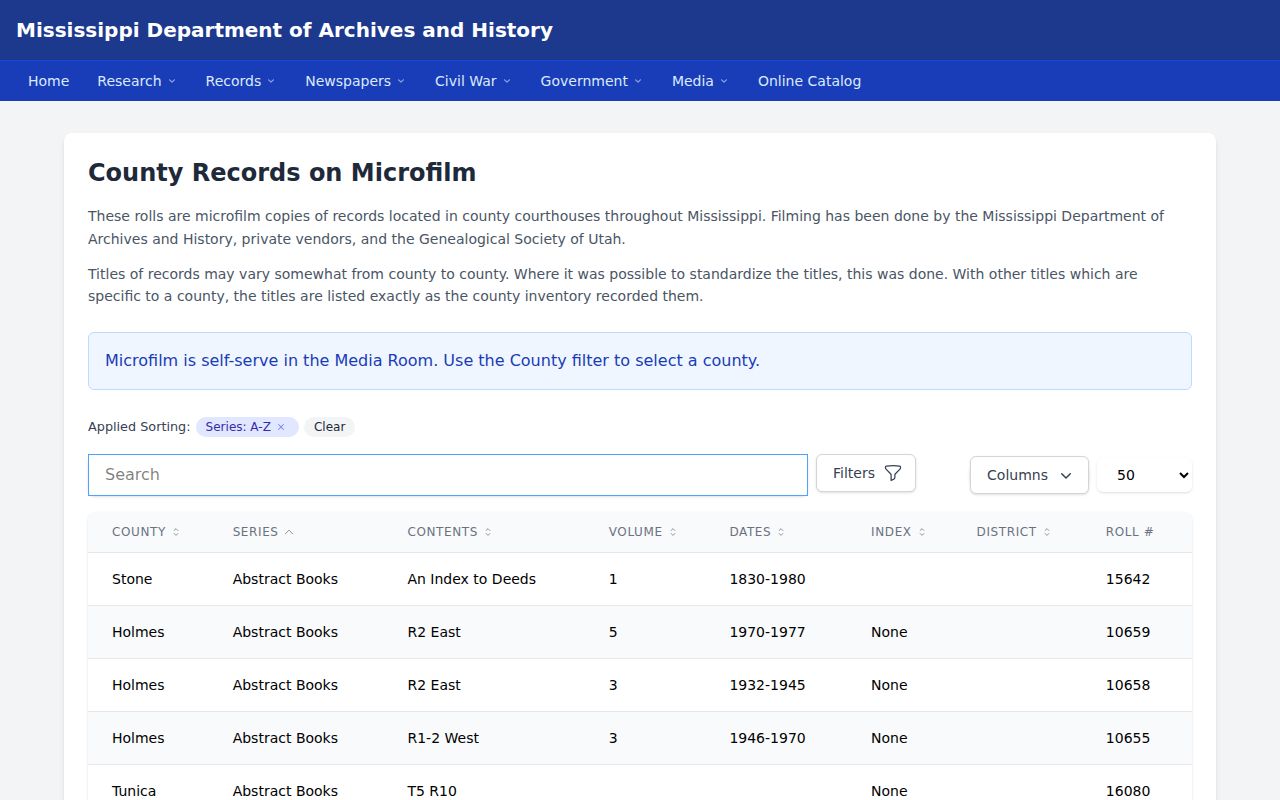
Carry the last confirmed owner, instrument type, book or volume, and year into the catalog. That turns a broad archival search into a focused request.
MDAH Series 2050 also holds early Wilkinson originals. These include accounts, affidavits, Board of Police business, tax-levy orders, road material, and court files. They add land context. None is a deed, so none belongs in the chain as a transfer.
Match Wilkinson’s Historic Land Words
Old Wilkinson instruments describe land by section, township, range, government lots, river or bayou landmarks, plantations, lot and block, and quarter sections. A present street address may be missing entirely. Compare each deed's boundaries and acreage with the parcel's modern legal fields, and preserve the original spellings in your notes.
Names shift too. Initials, married surnames, trustee language, and entity suffixes can split one person across index entries. Search the variants. Never join them on sound alone. A shared legal description or a prior-deed citation is the stronger link.
Centreville and Crosby cross the Wilkinson-Amite line. Check the county in the legal description whenever a tract sat near either town, since a prior owner may appear in another county's books despite a modern Wilkinson mailing address.
Resolve Gaps in Wilkinson Owner History
A chain of title in Wilkinson County can look broken when it really is not. Title sometimes moved through an estate, an executor's sale, or a chancery order. It also moved through a tax sale or a corrective deed. The Chancery Clerk holds more than deeds. Wills, estates, guardianships, conservatorships, and property disputes all sit in that office. A probate or court reference may explain the name change that puzzled you. Before assuming a parcel number skipped a generation, check those court files.
Family trees and obituaries help, but they cannot close the gap. Death notices and newspaper items can surface dates, heirs, and estate sales. They can also reveal spelling variants of an owner of record. The transfer still needs a deed, an executor's instrument, or a will. A court order behind it works too. A clean chain names the reason each owner changed. For one instrument and its copy options, the Wilkinson County deed records page explains the recorder's role. Former-owner work stays on sequence and time depth.
Bridge Wilkinson Deeds with Local Notices
Local newspapers can carry a deed across a gap. The Woodville Republican started in 1823 and printed legal notices, estate sales, foreclosure notices, property advertisements, deaths, and local addresses. Its name shifted over the years. Digital and microfilm runs survive only in pieces. Search each title variant around the deed or estate date, then confirm the clue against the county record itself.
Two archives widen the reach. MDAH lists early newspaper microfilm, and the Library of Congress supplies the title history plus digitized issues. A single notice can explain a sale or point to a prior owner of record. An absent notice means just that, nothing more.
Note: Newspaper names and dates can bridge a chain gap, but only the linked deed or court instrument should fill that transfer row.
Use Wilkinson County Former-Owner Records Carefully
Former-owner research serves real purposes. House history, estate work, and boundary questions all draw on Wilkinson County property records. Purchase due diligence draws on them too. None of it licenses contact that threatens, harasses, or targets a living person. Public access and lawful use are separate duties.
A rebuilt timeline is not a title opinion. Missing index entries can change the legal result. So can spelling shifts, multi-tract deeds, record gaps, and liens left unexamined. Before relying on the chain, verify its key links. Use the Chancery Clerk or a qualified title professional.
Chain limit. A negative online or newspaper search does not prove there was no prior owner or transfer. Continue through office indexes, deed books, and archival channels.